Pauline Viardot-Garcia
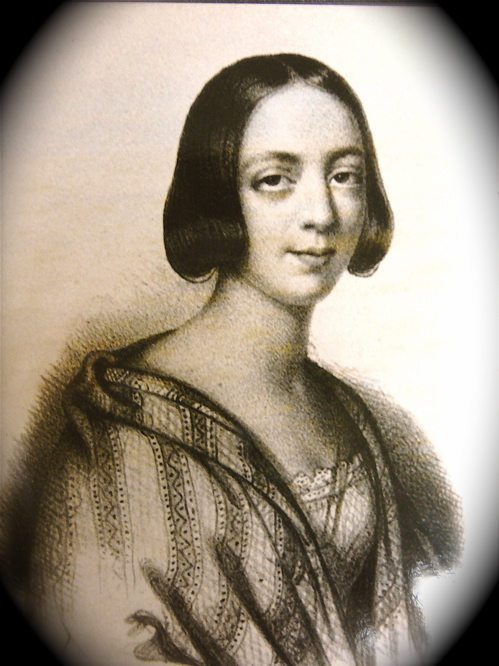
(1821-1910)
Pauline
Viardot-Garcia,
mezzo-soprano, composer and singing teacher, was born
in Paris on 18 July 1821 and died there on 18 May 1910. She
was the
youngest daughter of tenor Manuel
del Pópulo Vicente García
and mezzo-soprano Joaquina Briones. Her
elder brother was the renowned singing teacher Manuel
Patricio Garcia; her
elder sister
was the sensational mezzo-soprano, Maria Malibran.
As a child, only four years old, she traveled with her family to New York and Mexico from 1825 through 1829. In Mexico City she began early studies with Marcos Vega, organist of the cathedral. When eight years, old she performed at home in Paris for Gioacchino Rossini, eliciting prophecies that she would equal her sister as a singer ( Correo literario y marcantil de Madrid, 14 October 1829; quoted in Radomski, Manuel García, p. 282).
She had early lessons in singing with her father. After his death, in 1832, she was tutored by her mother and, especially, by her brother, Manuel Patricio Garcia. She later studied composition with Anton Reicha (1770-1836) at the Paris Conservatory and piano with Franz Liszt. Pauline originally had aspired to a career as a pianist and continued to play throughout her career. A close friend of Chopin's, she played duets with him, sang with him as her accompanist and arranged some of his Mazurkas for voice and piano.
Pauline made her operatic debut in London on 9 May 1839 (at the age of seventeen) as Desdemona in Rossini's Otello. Over the next years she performed other Rossini roles, including Rosina in Il barbiere di Siviglia.
On 18 April 1840 Pauline married the French writer, Louis Viardot (1800-1883), to whom she had been introduced by her lifelong friend, George Sand (1808-1875). They had four children: Louise (1841-1918), Claudie (1852-1914), Marie (18?-1919), and Paul 1857-1941). Louise had a significant career as contralto and composer as did Paul, as violinist, conductor and composer.
In 1843 Pauline toured Russia where she met the writer Ivan Turgenev (1818-1883). He became infatuated with Pauline and, in a somewhat bizarre relationship, followed her for the rest of his life—despite her marriage to Viardot.
In 1849 Pauline created the role of Fidès in the premiere of Meyerbeer's Le prophète in Paris. Other notable works she premiered were Sapho (1851) by Charles Gounod and the Alto Rhapsody (1869) by Johannes Brahms.
One of Pauline's greatest roles was that of Orpheus in a revival of Christoph Willibald Gluck's Orphée et Eurydice in Paris in 1859.
In 1863 she retired in Baden-Baden, due to her husband's political problems in Paris. After a brief stay in London in 1870 she returned to Paris where she spent the rest of her days teaching and composing. Of particular interest among her numerous compositions are the salon operas composed for her students: Trop de femmes (1867), L'ogre (1868), Le dernier sorcier (1869), Le conte de fées (1879) and Cendrillon (1904). The first three were composed to libretti by Tugenev, the latter two to her own libretti.
Pauline Viardot's Art:
Of the three children of Manuel del Pópulo García, Pauline was probably the most "artistic", in the sense of refinement and depth of interpretation—although she lacked the glamorous star charisma of her elder sister.
In a review of one of her earliest concerts, the writer Alfred de Musset (1810-1857) commented:
Elle chante comme elle respire; She sings as she breathes;
quoiqu'on sache qu'elle n'a que although one knows that she is only
dix-sept ans, son talent est si naturel, seventeen years old, her talent is so natural,
qu'on ne pense même pas à s'en étonner. that one doesn't think to be surprised.
Sa physionomie, pleine d'expression, Her features, full of expression,
change avec une rapidité prodigieuse, change with a prodigious speed,
avec une liberté extrême, non-seulement with an extreme liberty, not only
selon le morceau, mais selon la phrase according to the [entire] piece, but according to the phrase
qu'elle exécute. Elle possède, en un mot, that she executes. She possesses, in a word,
le grand secret des artistes; avant the great secret of artists: before
d'exprimer, elle sent. Ce n'est pas sa voix expressing, she feels. It is not her voice
qu'elle écoute, c'est son coeur, et si that she listens to, it is her heart, and if
Boileau a eu raison de dire: Boileau had reason to say:
Ce que l'on conçoit bien s'exprime clairement, What one has conceived well will be expressed clearly,
on peut dire avec assurance: Ce que l'on one can say with assurance: What one has
sent bien s'exprime mieux encore. felt well will be even better expressed.
A year later, in the same journal, George Sand affirmed that Pauline Garcia was a new kind of singer:
L'apparition de Mlle. Garcia sera un fait The appearance of Mlle. Garcia will be
éclatant dans l'histoire de l'art traité par a momentous event in the history of women
les femmes. Le génie de cette musicienne artists. The genius of this young musician,
à la fois consommée et inspirée constate at the same time consumate and inspired, constitutes
un progrès d'intelligence qui ne s'était point a progress of intelligence that has never existed
encore manifesté dans le sexe féminin d'une in the feminine sex in
manière aussi concluante. Jusqu'ici on such a conclusive manner. Until now one
avait dû accorder aux cantatrices une part has had to accord to female singers a part
de puissance égale à celle des plus grands of the skill equal to that of the greatest male
chanteurs. On a dit et écrit souvent que les singers. It has often been said that
femmes artistes pouvaient dans l'exécution female artists could, in performing,
s'élever au niveau des hommes, mais que rise to the level of men, but that
dans la conception des oeuvres d'art, elles in the composition of works of art, they
ne pouvaient dépasser une certaine portée could not pass beyond a certain level
de talent. On l'a dit moins haut peut-être of talent. It has been less often said, perhaps,
depuis que les efforts de quelques-unes that the efforts of some of these women have
d'entre elles ont montré une aptitude plus demonstrated an aptitude more or less
ou moins estimable pour la composition worthy for musical composition.
musicale. Pour le chant, il faut placer au As regards song, one must put in first place
premier rang quelques charmantes mélodies some charming melodies written by
qu'a écrites Mme Malibran; pour la scène, les Mme. Malibran; for the stage, the scores
partitions de Mlle Bertin. Mais voici une fille of Mlle. Bertin.1 But here is a girl,
de dix-huit ans qui écrit de la musique eighteen years old, who has written music
vraiment belle et forte, et de qui des artistes that is truly beautiful and strong, of which
très compétens et des plus sévères ont dit: some very competent and most demanding
"Montrez-nous ces pages, et dites-nous artists have said: "Show us these pages, and tell
qu'elles sont inédites de Weber ou de us that they are unpublished works of Weber or
Schubert, nous dirons qu'elles sont dignes Schubert; we will say that they are worthy of
d'être signées par l'un ou l'autre de ces being signed by one or the other of these great
grands noms, et plutôt encore par le premier names, and rather more by the first than by
que par le second." C'est là, ce nous semble, second." It seems to us that it is here that
le premier titre de Mlle Garcia à une gloire Mlle. Garcia lays claim to her premiere title of
impérissable. Supérieure à toutes les jeunes imperishable glory. Superior to all the young
cantatrices aujourd'hui connues en France singers known today in France
par la beauté de sa voix et la perfection de for the beauty of their voice and the perfection
son chant, elle peut mourir et ne pas s'envoler of their singing, she can die and not flee
comme ces apparitions de chanteurs et de like these apparitions of singers and
virtuoses qui, renfermés dans une grand virtuosos who, enclosed in a great
puissance d'exécution, ne laissent après power of performance, do not leave behind
eux que des souvenirs et des regrets; gloires them anything but memories and regrets—glories
qui s'effacent comme un beau rêve en that fade like a beautiful dream upon
disparaissant de la scène chargées de disappearing from the stage, filled with trophies,
trophées, mais condamnées à périr tout but condemned to completely perish,
entières, et de qui l'on peut dire ce qui est of whom one might say that which is written
écrit dans le libre divin à propos des heureux in the Divine Book in regard to those happy
de ce monde: "Ils ont reçus dès cette vie leur in this world: "They have received in this life
récompense." their reward."
Mlle Garcia est donc plus qu'une actrice, plus Mlle. Garcia is, therefore, more than an actress,
qu'une cantatrice. En l'écoutant, il y a plus que more than a singer. In hearing her, there is more
du plaisir et de l'émotion à se promettre; il y a pleasure and feeling promised; there is here
là un véritable enseignement, et nous ne a real education, and we do not doubt
doutons pas qu'avec le temps, la haute that, with time, the high degree of intelligence
intelligence qu'elle manifeste en chantant la that she displays in singing the music of
musique des maîtres, ne soit d'une heureuse masters, will have a good influence on the
influence sur le goût et l'instruction du public taste and instruction of the public as well
et des artistes. Elle est un de ces esprits as of artists. She is one of these creative spirits
créateurs qui ne s'embarrassent guère de la who do not worry about the tradition and
tradition et des usages introduits par les practices introduced by the
exigences de la voix ou la fantaisie maladroite requirements of the voice or the awkward
des exécutants ses devanciers. Elle entre dans performance fantasies of her predecessors.
l'esprit des auteurs; elle est seule avec eux dans She enters into the spirit of the composers;
sa pensée, et si elle adopte un trait, si elle she is alone with them in her way of thinking,
prononce une phrase, elle en rétablit le sens and if she adopts an embellishment, if she
corrompu, elle en retrouve la lettre perdue. Le sings a phrase, she restores the sense that has
public qui l'aime, mais qui n'a pas encore en been corrupted, she finds there the lost meaning.
elle toute la confiance qu'elle mérite, s'étonne The public, which loves her but which does not
et s'effraie quelquefois de ce qu'il prend pour yet have the complete confidence in her that she
une innovation. Le public n'est pas assez savant deserves, is at times astonished and frightened
pour lui contester avec certitude la liberté de by this which it takes to be an innovation.
ses allures. La plupart des journalistes ne le The public is not knowledgeable enough to respond
sont pas davantage, et moi qui écris ceci, je le to the freedom of her musical innovations. The majority
suis moins que le dernier d'entre eux. Mais ce of journalists are not much better, and I, who write
que le public, ce que les critiques, ce que this, am less than the least among them. But this which
moi-même pouvons examiner sans craindre the public, which the critics, which I myself
de faire rire les vrais savans, et sans autre can examine without fear of making true
conseil que celui de notre logique et de notre connoisseurs laugh, and without any other counsel
sentiment, c'est précisément le sentiment et la than that of our logic and our feeling, is precisely
logique qui président à ce travail consciencieux the feeling and the logic which presides over this
auquel Mlle Garcia soument l'oeuvre qu'elle conscientious labor to which Mlle. Garcia submits
chante. Jamais elle ne dénature l'idée, jamais the piece that she sings. She never kills the idea,
elle ne substitue son esprit à l'esprit du never substitutes her own spirit for the spirit of the
compositeur. Le jour où vous direz: Mozart composer. When you say, "Mozart didn't
n'eût pas écrit cela, ce jour-là seulement vous write that," you only have the right to say
serez en droit de dire que Mozart ne l'a point that Mozart didn't write it; but if you always
écrit; mais si vous retrouvez toujours et partout and everywhere find the spirit and feeling of the
l'esprit et le sentiment du maître, vous pouvez Master, you can say that if the Master didn't write
dire que si le maître ne l'a pas écrit ainsi, it that way, at least he felt it that way at the moment
c'est ainsi du moins qu'il l'a senti dans le moment of inspiration and, thus, that he might have written
de l'inspiration, et c'est ainsi qu'il l'aurait écrit it that way the day before or the day after. Thus
peut-être la veille ou le lendemain. Ainsi c'est it is always Mozart, it is always Rossini that we
bien toujours du Mozart, c'est bien toujours du are hearing, even when, to satisfy the
Rossini que nous entendons, lors même que demands of the voice that had to serve to
pour satisfaire aux exigences de la voix qui interpret his music, Rossini or Mozart consented
devait lui servir d'interprète, Rossini ou Mozart to modify their first draft. ...There is a certain
ont consenti à modifier leur premier jet. ....Il y a respect for her that truly eminent artists do not
pour lui un certain respect auquel ne se refusent refuse. I have seen Rubini rehearsing docilely
pas les artistes vraiment éminents. J'ai vu with Pauline Garcia, during intermission, an
Rubini essayer docilement avec Pauline Garcia, ornament that she wrote for him, and that the
dans l'entr'acte, un trait qu'elle lui avait soumis, admirable singer repeated with a naïve and
et que l'admirable chanteur répétait avec un generous pleasure. Lablache is proud of
plaisir naïf et généreux. Lablache est fier d'elle her as a father is of his child, and Liszt (to whom
comme un père l'est de son enfant, et Liszt sera she is, as pianist, one of his best students) will be
plus heureux de l'entendre chanter Desdemona happier to hear her sing Desdemona and
et Tancrède, lui dont elle est, comme pianiste, Tancred, than to receive all the ovations with which
une des meilleures élèves, que de toutes les his good Hungary awards him.
ovations que sa bonne Hongrie lui décerne.
BIBLIOGRAPHY
April FitzLyon, The Price of Genius: A Biography of Pauline Viardot (London: John Calder, 1964).
PUBLISHED WORKS OF PAULINE VIARDOT-GARCIA
“UNA VOCE POCO FA …” ovvero le musiche delle Primedonne Rossiniane
(collection of songs and arias composed by some of Rossini’s ‘leading ladies’)
ed. Patricia Adkins Chiti, (Rome: Garamond Edizioni Musicali, c. 1992).
Songs and Duets of García, Malibran and Viardot: Rediscovered Songs by Legendary Singers,
ed. Patricia Adkins Chiti, Phonetic Transcriptions by John Glenn Paton, ( [Van Nuys, California]: Alfred Publishing Company, Inc., c. 1997).
Twelve Lieder, ed. Catherine Sentman Anderson, (Bryn Mawr, Pennsylvania: Hildegard Publishing Company, c. 1994).
[First published in St. Petersburg in 1864, and issued the following year by Breitkopf & Härtel in Leipzig, with German translations by Fr. Bodenstedt]
13 Songs for Voice and Piano
(Fayetteville, Arkansas: Classical Vocal Reprints, c. 1997), Catalog No. CVR 2641.
Three Duets (Two Voices and Piano)
(Fayetteville, Arkansas: Classical Vocal Reprints, c. 1997), Catalog No. CVR 2663.
As a child, only four years old, she traveled with her family to New York and Mexico from 1825 through 1829. In Mexico City she began early studies with Marcos Vega, organist of the cathedral. When eight years, old she performed at home in Paris for Gioacchino Rossini, eliciting prophecies that she would equal her sister as a singer ( Correo literario y marcantil de Madrid, 14 October 1829; quoted in Radomski, Manuel García, p. 282).
She had early lessons in singing with her father. After his death, in 1832, she was tutored by her mother and, especially, by her brother, Manuel Patricio Garcia. She later studied composition with Anton Reicha (1770-1836) at the Paris Conservatory and piano with Franz Liszt. Pauline originally had aspired to a career as a pianist and continued to play throughout her career. A close friend of Chopin's, she played duets with him, sang with him as her accompanist and arranged some of his Mazurkas for voice and piano.
Pauline made her operatic debut in London on 9 May 1839 (at the age of seventeen) as Desdemona in Rossini's Otello. Over the next years she performed other Rossini roles, including Rosina in Il barbiere di Siviglia.
On 18 April 1840 Pauline married the French writer, Louis Viardot (1800-1883), to whom she had been introduced by her lifelong friend, George Sand (1808-1875). They had four children: Louise (1841-1918), Claudie (1852-1914), Marie (18?-1919), and Paul 1857-1941). Louise had a significant career as contralto and composer as did Paul, as violinist, conductor and composer.
In 1843 Pauline toured Russia where she met the writer Ivan Turgenev (1818-1883). He became infatuated with Pauline and, in a somewhat bizarre relationship, followed her for the rest of his life—despite her marriage to Viardot.
In 1849 Pauline created the role of Fidès in the premiere of Meyerbeer's Le prophète in Paris. Other notable works she premiered were Sapho (1851) by Charles Gounod and the Alto Rhapsody (1869) by Johannes Brahms.
One of Pauline's greatest roles was that of Orpheus in a revival of Christoph Willibald Gluck's Orphée et Eurydice in Paris in 1859.
In 1863 she retired in Baden-Baden, due to her husband's political problems in Paris. After a brief stay in London in 1870 she returned to Paris where she spent the rest of her days teaching and composing. Of particular interest among her numerous compositions are the salon operas composed for her students: Trop de femmes (1867), L'ogre (1868), Le dernier sorcier (1869), Le conte de fées (1879) and Cendrillon (1904). The first three were composed to libretti by Tugenev, the latter two to her own libretti.
Pauline Viardot's Art:
Of the three children of Manuel del Pópulo García, Pauline was probably the most "artistic", in the sense of refinement and depth of interpretation—although she lacked the glamorous star charisma of her elder sister.
In a review of one of her earliest concerts, the writer Alfred de Musset (1810-1857) commented:
Elle chante comme elle respire; She sings as she breathes;
quoiqu'on sache qu'elle n'a que although one knows that she is only
dix-sept ans, son talent est si naturel, seventeen years old, her talent is so natural,
qu'on ne pense même pas à s'en étonner. that one doesn't think to be surprised.
Sa physionomie, pleine d'expression, Her features, full of expression,
change avec une rapidité prodigieuse, change with a prodigious speed,
avec une liberté extrême, non-seulement with an extreme liberty, not only
selon le morceau, mais selon la phrase according to the [entire] piece, but according to the phrase
qu'elle exécute. Elle possède, en un mot, that she executes. She possesses, in a word,
le grand secret des artistes; avant the great secret of artists: before
d'exprimer, elle sent. Ce n'est pas sa voix expressing, she feels. It is not her voice
qu'elle écoute, c'est son coeur, et si that she listens to, it is her heart, and if
Boileau a eu raison de dire: Boileau had reason to say:
Ce que l'on conçoit bien s'exprime clairement, What one has conceived well will be expressed clearly,
on peut dire avec assurance: Ce que l'on one can say with assurance: What one has
sent bien s'exprime mieux encore. felt well will be even better expressed.
(Alfred de
Musset,
"Concert de Mademoiselle Garcia," Revue
des Deux Mondes, 1 Janvier 1839, p. 112)
A year later, in the same journal, George Sand affirmed that Pauline Garcia was a new kind of singer:
L'apparition de Mlle. Garcia sera un fait The appearance of Mlle. Garcia will be
éclatant dans l'histoire de l'art traité par a momentous event in the history of women
les femmes. Le génie de cette musicienne artists. The genius of this young musician,
à la fois consommée et inspirée constate at the same time consumate and inspired, constitutes
un progrès d'intelligence qui ne s'était point a progress of intelligence that has never existed
encore manifesté dans le sexe féminin d'une in the feminine sex in
manière aussi concluante. Jusqu'ici on such a conclusive manner. Until now one
avait dû accorder aux cantatrices une part has had to accord to female singers a part
de puissance égale à celle des plus grands of the skill equal to that of the greatest male
chanteurs. On a dit et écrit souvent que les singers. It has often been said that
femmes artistes pouvaient dans l'exécution female artists could, in performing,
s'élever au niveau des hommes, mais que rise to the level of men, but that
dans la conception des oeuvres d'art, elles in the composition of works of art, they
ne pouvaient dépasser une certaine portée could not pass beyond a certain level
de talent. On l'a dit moins haut peut-être of talent. It has been less often said, perhaps,
depuis que les efforts de quelques-unes that the efforts of some of these women have
d'entre elles ont montré une aptitude plus demonstrated an aptitude more or less
ou moins estimable pour la composition worthy for musical composition.
musicale. Pour le chant, il faut placer au As regards song, one must put in first place
premier rang quelques charmantes mélodies some charming melodies written by
qu'a écrites Mme Malibran; pour la scène, les Mme. Malibran; for the stage, the scores
partitions de Mlle Bertin. Mais voici une fille of Mlle. Bertin.1 But here is a girl,
de dix-huit ans qui écrit de la musique eighteen years old, who has written music
vraiment belle et forte, et de qui des artistes that is truly beautiful and strong, of which
très compétens et des plus sévères ont dit: some very competent and most demanding
"Montrez-nous ces pages, et dites-nous artists have said: "Show us these pages, and tell
qu'elles sont inédites de Weber ou de us that they are unpublished works of Weber or
Schubert, nous dirons qu'elles sont dignes Schubert; we will say that they are worthy of
d'être signées par l'un ou l'autre de ces being signed by one or the other of these great
grands noms, et plutôt encore par le premier names, and rather more by the first than by
que par le second." C'est là, ce nous semble, second." It seems to us that it is here that
le premier titre de Mlle Garcia à une gloire Mlle. Garcia lays claim to her premiere title of
impérissable. Supérieure à toutes les jeunes imperishable glory. Superior to all the young
cantatrices aujourd'hui connues en France singers known today in France
par la beauté de sa voix et la perfection de for the beauty of their voice and the perfection
son chant, elle peut mourir et ne pas s'envoler of their singing, she can die and not flee
comme ces apparitions de chanteurs et de like these apparitions of singers and
virtuoses qui, renfermés dans une grand virtuosos who, enclosed in a great
puissance d'exécution, ne laissent après power of performance, do not leave behind
eux que des souvenirs et des regrets; gloires them anything but memories and regrets—glories
qui s'effacent comme un beau rêve en that fade like a beautiful dream upon
disparaissant de la scène chargées de disappearing from the stage, filled with trophies,
trophées, mais condamnées à périr tout but condemned to completely perish,
entières, et de qui l'on peut dire ce qui est of whom one might say that which is written
écrit dans le libre divin à propos des heureux in the Divine Book in regard to those happy
de ce monde: "Ils ont reçus dès cette vie leur in this world: "They have received in this life
récompense." their reward."
Mlle Garcia est donc plus qu'une actrice, plus Mlle. Garcia is, therefore, more than an actress,
qu'une cantatrice. En l'écoutant, il y a plus que more than a singer. In hearing her, there is more
du plaisir et de l'émotion à se promettre; il y a pleasure and feeling promised; there is here
là un véritable enseignement, et nous ne a real education, and we do not doubt
doutons pas qu'avec le temps, la haute that, with time, the high degree of intelligence
intelligence qu'elle manifeste en chantant la that she displays in singing the music of
musique des maîtres, ne soit d'une heureuse masters, will have a good influence on the
influence sur le goût et l'instruction du public taste and instruction of the public as well
et des artistes. Elle est un de ces esprits as of artists. She is one of these creative spirits
créateurs qui ne s'embarrassent guère de la who do not worry about the tradition and
tradition et des usages introduits par les practices introduced by the
exigences de la voix ou la fantaisie maladroite requirements of the voice or the awkward
des exécutants ses devanciers. Elle entre dans performance fantasies of her predecessors.
l'esprit des auteurs; elle est seule avec eux dans She enters into the spirit of the composers;
sa pensée, et si elle adopte un trait, si elle she is alone with them in her way of thinking,
prononce une phrase, elle en rétablit le sens and if she adopts an embellishment, if she
corrompu, elle en retrouve la lettre perdue. Le sings a phrase, she restores the sense that has
public qui l'aime, mais qui n'a pas encore en been corrupted, she finds there the lost meaning.
elle toute la confiance qu'elle mérite, s'étonne The public, which loves her but which does not
et s'effraie quelquefois de ce qu'il prend pour yet have the complete confidence in her that she
une innovation. Le public n'est pas assez savant deserves, is at times astonished and frightened
pour lui contester avec certitude la liberté de by this which it takes to be an innovation.
ses allures. La plupart des journalistes ne le The public is not knowledgeable enough to respond
sont pas davantage, et moi qui écris ceci, je le to the freedom of her musical innovations. The majority
suis moins que le dernier d'entre eux. Mais ce of journalists are not much better, and I, who write
que le public, ce que les critiques, ce que this, am less than the least among them. But this which
moi-même pouvons examiner sans craindre the public, which the critics, which I myself
de faire rire les vrais savans, et sans autre can examine without fear of making true
conseil que celui de notre logique et de notre connoisseurs laugh, and without any other counsel
sentiment, c'est précisément le sentiment et la than that of our logic and our feeling, is precisely
logique qui président à ce travail consciencieux the feeling and the logic which presides over this
auquel Mlle Garcia soument l'oeuvre qu'elle conscientious labor to which Mlle. Garcia submits
chante. Jamais elle ne dénature l'idée, jamais the piece that she sings. She never kills the idea,
elle ne substitue son esprit à l'esprit du never substitutes her own spirit for the spirit of the
compositeur. Le jour où vous direz: Mozart composer. When you say, "Mozart didn't
n'eût pas écrit cela, ce jour-là seulement vous write that," you only have the right to say
serez en droit de dire que Mozart ne l'a point that Mozart didn't write it; but if you always
écrit; mais si vous retrouvez toujours et partout and everywhere find the spirit and feeling of the
l'esprit et le sentiment du maître, vous pouvez Master, you can say that if the Master didn't write
dire que si le maître ne l'a pas écrit ainsi, it that way, at least he felt it that way at the moment
c'est ainsi du moins qu'il l'a senti dans le moment of inspiration and, thus, that he might have written
de l'inspiration, et c'est ainsi qu'il l'aurait écrit it that way the day before or the day after. Thus
peut-être la veille ou le lendemain. Ainsi c'est it is always Mozart, it is always Rossini that we
bien toujours du Mozart, c'est bien toujours du are hearing, even when, to satisfy the
Rossini que nous entendons, lors même que demands of the voice that had to serve to
pour satisfaire aux exigences de la voix qui interpret his music, Rossini or Mozart consented
devait lui servir d'interprète, Rossini ou Mozart to modify their first draft. ...There is a certain
ont consenti à modifier leur premier jet. ....Il y a respect for her that truly eminent artists do not
pour lui un certain respect auquel ne se refusent refuse. I have seen Rubini rehearsing docilely
pas les artistes vraiment éminents. J'ai vu with Pauline Garcia, during intermission, an
Rubini essayer docilement avec Pauline Garcia, ornament that she wrote for him, and that the
dans l'entr'acte, un trait qu'elle lui avait soumis, admirable singer repeated with a naïve and
et que l'admirable chanteur répétait avec un generous pleasure. Lablache is proud of
plaisir naïf et généreux. Lablache est fier d'elle her as a father is of his child, and Liszt (to whom
comme un père l'est de son enfant, et Liszt sera she is, as pianist, one of his best students) will be
plus heureux de l'entendre chanter Desdemona happier to hear her sing Desdemona and
et Tancrède, lui dont elle est, comme pianiste, Tancred, than to receive all the ovations with which
une des meilleures élèves, que de toutes les his good Hungary awards him.
ovations que sa bonne Hongrie lui décerne.
(George Sand, "Le
Théâtre-Italien et Mlle. Pauline
Garcia," Revue des deux
mondes,
Fevrier, 1840, pp. 586-588)
1Louise Angelique Bertin
(1805-1877).BIBLIOGRAPHY
April FitzLyon, The Price of Genius: A Biography of Pauline Viardot (London: John Calder, 1964).
PUBLISHED WORKS OF PAULINE VIARDOT-GARCIA
“UNA VOCE POCO FA …” ovvero le musiche delle Primedonne Rossiniane
(collection of songs and arias composed by some of Rossini’s ‘leading ladies’)
ed. Patricia Adkins Chiti, (Rome: Garamond Edizioni Musicali, c. 1992).
Songs and Duets of García, Malibran and Viardot: Rediscovered Songs by Legendary Singers,
ed. Patricia Adkins Chiti, Phonetic Transcriptions by John Glenn Paton, ( [Van Nuys, California]: Alfred Publishing Company, Inc., c. 1997).
Twelve Lieder, ed. Catherine Sentman Anderson, (Bryn Mawr, Pennsylvania: Hildegard Publishing Company, c. 1994).
[First published in St. Petersburg in 1864, and issued the following year by Breitkopf & Härtel in Leipzig, with German translations by Fr. Bodenstedt]
13 Songs for Voice and Piano
(Fayetteville, Arkansas: Classical Vocal Reprints, c. 1997), Catalog No. CVR 2641.
Three Duets (Two Voices and Piano)
(Fayetteville, Arkansas: Classical Vocal Reprints, c. 1997), Catalog No. CVR 2663.
—James
Radomski