Salve
Regina
(1828)
During the summer of 1828 there was a drought in Mexico and so a
special novena to Our Lady of Remedios was held to seek Mary's
intercession for a divine solution to the problem. The novena was
to
end
with a special performance of Manuel García's
Salve Regina in the
Cathedral.
This
was not to be, however, because García was to find himself (and
his Salve Regina) a pawn
in a
dispute between liberals (the city's politicians) and
conservatives
(the Church hierarchy). The Cathedral Chapter didn't want to have
worldly opera singers in the Cathedral and insisted that the Salve at the end of the
novena be
sung by a religious order. Their argument was that, by having
actors in
the Cathedral, the congregation might confuse a "place of worship"
with
a "place of entertainment." The liberal Correo de la federación mexicana
lashed out against the Chapter's decision:
But
that
which cries for the festive pen of Molière or the caustic
one of Voltaire is the notion that the Chapter should avoid the danger
that the public might focus its attention on the merit of the music and on those who perform it with their
voices and
their instruments. That is to say that, in order to
avoid such a
'danger', only a lousy
flautist
should play in the Cathedral and that the worse the music is,
the
better served will be the worhip of God and His saints. Have we
forgotten that God enjoyed David's harp?
...Furthermore, for the
Chapter to
be consistent, they should prohibit the musicians of the
Cathedral
choir from ever belonging to the theatre orchestra so that the public will not confuse it
with the
holy place of worship; likewise, they should be ordered
to never
play at dances, weddings or
parties
because the public might confuse these with the holy place of worship. What
foolishness
arises when things are done thoughtlessly! May Sr.
García be consoled by the thought that God and the Holy Virgin
and we also appreciate his Salve.
(20 June 1828; quoted in Radomski, Manuel
García, p. 226)
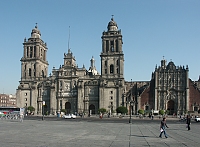
Mexico City Cathedral
photo Mary Ann Sullivan
Be that as it may, the Salve
Regina
is a charming compact work that recently received its world
premiere in
performances by the California State University San Bernardino
Chamber
Singers on their tour of Spain (summer 2010) under the direction
of Andrew
Crane.
1Molly Nelson-Haber has recently
brought to
my
attention the fact that García was a member of the prestigious
masonic lodge, Les Chevaliers
de la
Croix, in east Paris as early as 1811. This merits
further
exploration! See "NEUKOMM et la
Franc-Maçonnerie" at: http://www.musimem.com/neukomm.htm
Download the vocal score of García's Salve Regina:
1.
Salve
Regina
2.
Ad
te clamamus
3.
Eia
ergo
4.
Et
Jesum
5.
O
Clemens
This music is for personal use
only.
All copyright restrictions apply.
[Return to Homepage]