L'isola disabitata (1831)

courtesy of Asad Photo, Maldives
L'isola disabitata (The Uninhabited
Island) was one of five
salon operas with piano accompaniment that comprised the very last
works composed by Manuel García.
The text, by Pietro Metastasio, had originally been set by
Giuseppe Bonno and premiered in Aranjuez, Spain, on 31 May 1753.
It was later set by other composers, including Haydn (1779) and
Paisiello (1799). Metastasio always considered L'isola
disabitata one of his favorite works: in 1768 he reflected,
"L'isola disabitata, in the future, will always be the most
beloved of my children, among all her many older or younger
siblings." (Brunelli, Tutte le opere di Pietro Metastasio, vol. 4 (Milan: A. Mondadori, 1954),
p. 661; quoted in García, L'isola disabitata, ed. Teresa Radomski and James
Radomski (Middleton, Wisconsin: A-R Editions, 2006), p. xi).
The
story,
a product of the "Arcadian movement" of the early eighteenth
century, obviously had considerable appeal—and one can see why.
It is simple, the characters are attractive and the plot serves
to display virtues honored in any age: fidelity, constancy, and
perseverance in the midst of life's sorrows. And the setting, on
a desert isle, offered the sort of exoticism—such as found in
Daniel Defoe's Robinson Crusoe (1719)—that appealed to the
eighteenth-century fancy. There are only four characters (apart
from the silent roles of two sailors): the heroine, Costanza;
her younger sister Silvia; Gernando, the husband of Costanza;
and his friend, Enrico. The scene is an uninhabited island
where, thirteen years before, Gernando brought Costanza and
Silvia ashore to take refuge from a storm while the crew
remained with the ship. As Costanza was sleeping, and
unbeknownst to her, pirates attacked and kidnapped Gernando,
leaving Costanza and Silvia alone on the island. Costanza,
convinced that she had been abandoned by Gernando, appears in
the opening scene carving, in stone, a memorial of her fate. She
expresses her sadness to Silvia, who is optimistic and content
with life on the island. Silvia later sees a ship approach and
encounters Enrico, who has come with Gernando to seek Costanza.
Only an infant at the time of Gernando's abduction, Silvia has
no memory of ever having seen a man and Costanza has taught her
to fear ever seeing one. Nonetheless, she is charmed by Enrico.
Meanwhile, Gernando has found Costanza by the rock she is
carving, and she faints upon recognizing him. He goes for water
to revive her and it is Enrico, instead of Gernando, whom
Costanza sees upon waking. She rails against Gernando's supposed
infidelity, but Enrico explains to her what had actually
happened years ago and how much Gernando has suffered at the
loss of Costanza. Thus, they are finally happily reunited while
Enrico asks Silvia for her hand in marriage. The two couples
sing a final chorus proclaiming the virtue of "constancy," in a
play of words on the name of the heroine. (from L'isola
disabitata, ed.
Teresa Radomski and James Radomski, p. xi)
There is no record of a
performance of L'isola disabitata during García's lifetime. It was
premiered at Wake Forest University on 7 April 2005 with Mary
Mendenhall as Costanza, Amanda Castellone as Silvia, Ricardo Gómez
as Gernando and Christopher Magiera as Enrico. Stage direction was
by Jim Dodding and musical direction by Teresa Radomski. Thomas
Turnbull was the pianist. L'isola
disabitata received its European premiere in February
and March of 2010 at the Teatro Arriaga (Bilbao) and the Teatro de
la Maestranza (Seville). Performers were Carmen Romeu as
Constanza, Marifé Nogales as Silvia, Jesús Álvarez as Gernando,
César San Martín as Enrico. Rubén Fernández Aguirre was pianist
and Musical Director; Emilio Sagi was Stage Director.
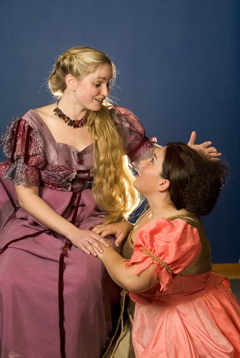
Mary Mendenhall and Amanda Castellone
Listen
to:
1. Duet, Scene
IV, "O desiato lido" (Gernando and Enrico) [8:37]
Sung by Ricardo Gómez and
Christopher Magiera.
GERNANDO
GERNANDO
O desiato
lido
Oh deserted
shore
Dove il mio ben
perdei,
where I lost my beloved.
Quest’ è il terren, oh
Dei,
This is the place, oh
Gods,
Sì, me lo dice il cor.
yes, my heart tells me so.
ENRICO
ENRICO
Credi che il luogo
sia,
You believe that this must be the place,
E tu sicuro
sei.
and you are
certain.
Sì amico lo
vorrei,
Yes, friend, I wish it,
Ma dubbito finor.
but yet I doubt it.
GERNANDO
GERNANDO
No, caro,
riconosco
No, dear friend, I recognize
Quel sasso, quello
speco
that rock,
that cave
Dove fui dai pirati ferito con
orror.
where I was horribly wounded by
pirates.
Mia Costanza dormiva,
My Costanza was
sleeping,
E per l’ultima volta
and for the last time,
Lasciai l’anima mia
pierced with grief,
Traffito dal dolor
I left my soul behind.
ENRICO
ENRICO
Sì, andiamo amico
caro,
Yes, let’s go, dear
friend,
Cerchiam per ogni
lato,
Let’s search
everywhere.
Cercala per quel
prato
You search for her in that meadow,
Per questo io
cercherò
I will
search in this one.
- GERNANDO
GERNANDO
- Sì, andiamo amico caro,
Yes, let’s go dear friend,
- andiam ma io no spero affatto
let’s go, but I do not completely
hope
- di ritrovarla intanto
to find her again; meanwhile
- sua tomba io troverò.
I will find
her tomb.
- ENRICO
ENRICO
- Andiam, andiam, amico caro,
Let’s go, let’s go dear friend,
- andiam, ma cerca per quel prato
let’s
go, but search in that meadow
- di ritrovarla; intanto
to find her again; meanwhile
- per questo io cercherò.
I will search
here.
GERNANDO
GERNANDO
Questo è il terren, oh Dei,
This is the
place, oh Gods,
sì, me lo dice il cor.
yes, my heart
tells me so.
GERNANDO/ENRICO
GERNANDO/ENRICO
Andiam, andiamo amico caro, (etc.)
Let’s go,
let’s go dear friend, (etc.)
- GERNANDO
GERNANDO
- E la tomba di lei
And at her tomb
- la mia tomba farò.
will make my own grave.
- ENRICO
ENRICO
- Ah, se possiam trovarla
Ah, if we are
able to find her
- io felice si sarò.
I will be so happy.
GERNANDO/ENRICO
GERNANDO/ENRICO
Andiam, andiamo amico caro, (etc.)
Let’s go, let’s go dear friend, (etc.)
GERNANDO
GERNANDO
Questo è il terren, oh Dei,
This is the
place, oh Gods,
sì, me lo dice il cor.
yes, my heart
tells me so.
GERNANDO/ENRICO
GERNANDO/ENRICO
Andiam, andiamo amico caro, (etc.)
Let’s go, let’s go dear friend, (etc.)
- GERNANDO
GERNANDO
- E la tomba di lei
And at her tomb
- la mia tomba farò.
will make my own grave.
- ENRICO
ENRICO
- Ah, se possiam trovarla
Ah, if we are
able to find her
- io felice si sarò.
I will be so happy
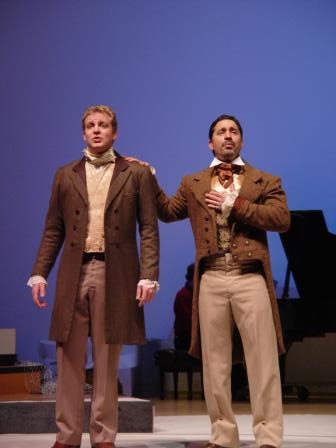 Christopher
Magiera
and Ricardo Gómez
Christopher
Magiera
and Ricardo Gómez
Sung by
Amanda Castellone and Christopher Magiera.
ENRICO
ENRICO
Non mi fuggir così!
Do not flee from me like this!
Fermati per pietà!
Stop, for pity’s sake!
Dimmi perché sei qui;
Tell me why you are here;
sento di te pietà.
I feel sorry for you.
SILVIA
SILVIA
Uomo pietà, sì, sì!
Sir, have pity, yes, yes!
Non farmi nessun mal!
Don’t do me any harm!
Guarda, ch’io pianga qui.
Behold, I’m
crying here.
Fallo, per carità!
Let me go, please!
ENRICO
ENRICO
Che sembiante gentil!
What a charming face!
Sorgi, sorgi, sorgi a pensa a calmar.
Get up, get up,
get up and calm down.
SILVIA
SILVIA
Il cor mi dice a lui
My heart tells me:
tu ti potrai fidar.
“You can trust him.”
Sì,sì, il cor mi dice,
Yes, yes, my heart tells me:
tu ti potrai fidar
“You can
trust him.”
ENRICO
ENRICO
Dimmi perché sei qui.
Tell me why you’re here.
SILVIA
SILVIA
Non farmi nessun mal!
Don’t do me any harm!
ENRICO
ENRICO
Sento di te pietà
I feel
sorry for you.
SILVIA
SILVIA
Fallo per carità, per carità, per carità!
Let me go,
please, please, please!
Uomo, pietà, sì, sì!
Sir, have pity, yes yes!
ENRICO
ENRICO
Non mi fuggir così!
Do not flee from me like
this!
SILVIA
SILVIA
Non farmi nessun mal!
Don’t do me any harm!
ENRICO
ENRICO
Fermati, per pietà!
Stop, for pity’s sake!
SILVIA
SILVIA
Guarda ch’io piango qui.
Behold,
I’m crying here.
Fallo per carità!
Let me go,
please!
Uomo pietà, sì, sì ... (ecc.)
Sir, have pity, yes, yes!
... (etc.)
ENRICO
ENRICO
Dimmi perché sei qui,
Tell me why you’re here;
sì sento di te pietà.
yes, I feel sorry for you.
Non mi fuggir così ... (repeated text)
Do not flee from
me like this ... (repeated text)
SILVIA
SILVIA
Il cor mi dice a lui
My heart tells me
tu ti potrai fidar, sì,
“You can trust him, yes,
tu ti potrai fidar, sì, sì ... (repeated text)
you can trust him, yes, yes” ...
(repeated text)
ENRICO
ENRICO
Che sembiante gentil!
What a charming face!
Di me ti poi fidar,
You can trust me,
di me ti poi fidar, sì, sì ... (repeated
text) you can trust me, yes,
yes ... (repeated text)
3. Aria, Scene
XI, "Ah, che in van" (Costanza) [9:19]
Sung by Mary Mendenhall.
COSTANZA
COSTANZA
Ah, che in van per me pietoso
Ah, vainly for me does
time
fugge il tempo e affretta il passo:
mercifully flee and hasten
its steps.
cede agli anni il tronco, il sasso;
The trees and
rocks give way to the years,
non invecchia il mio martir.
but my agony does not
grow old.
Non è vita una tal sorte;
Such a
fate is not life;
ma sì lunga è questa morte,
but so prolonged is this death,
ch’io son stanca di morir.
that I am
tired of dying.
(translation from
L'isola
disabitata, ed. Teresa Radomski and James Radomski)
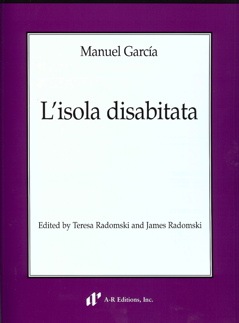
The complete score of
L'isola
disabitata is available for purchase at the A-R Editions
website.
Click to order:
The complete recording can be
played/downloaded for free:
L'isola disabitata
Libretto
1:
Overtura
2:
Scena
prima. Recitativo
(Costanza) "Qual contrasto non vince"
3:
Scena
seconda. Aria
(Silvia) "Che piacere, che contento"
4:
Recitativo (Silvia,
Costanza) "Ah germana! Ah Costanza!"
5:
Duetto (Costanza,
Silvia) "Ah tu del ben, che ignori"
6:
Scena
terza. Recitativo
(Silvia) "Che ostinato dolor!"
7:
Scena
quarta. Duetto
(Gernando, Enrico) "O desiato lido"
8:
Scena
quinta. Recitativo
(Silvia, Enrico) "Nulla intender poss'io"
9:
Recitativo (Silvia)
"Che fu mai ch'io vidi!"
10:
Aria (Silvia) "Fra
un dolce deliro"
11:
Scena
sesta. Recitativo
(Gernando, Enrico) "Ah! Presaga fu l'alma"
12:
Aria (Gernando)
"Parti amico"
13:
Scena
settima. Recitativo
(Enrico) "Non s'irrìti fra' primi impeti"
14:
Scena
ottava. Recitativo
(Silvia, Enrico) "Dov'è Costanza?"
15:
Duetto (Enrico,
Silvia) "Non mi fuggir così"
16:
Recitativo (Enrico,
Silvia) "Dì, se cortesi sei"
17:
Scena
nona. Aria
(Costanza) "Ah che in van per me pietoso"
18:
Scena
decima. Recitativo
(Costanza) "Giacché da me lontana"
Recitativo (Gernando,
Costanza) "Giacché il pietoso amico"
Recitativo (Enrico, Costanza) "Ignora il caro amico"
19:
Final (Enrico,
Costanza) "Tu non sogni è non sognasti" (Silvia, Costanza,
Enrico, Gernando)
"Costanza il tuo Gernando"
20:
Quartetto
(Costanza, Gernando, Sivia, Enrico) "Ed è vero?"
21:
(Silvia,
Enrico, Costanza, Gernando) "Guarda Enrico a Gernando"
Coro
(Costanza, Silvia, Gernando, Enrico) "Allor che il ciel
s'imbruna"