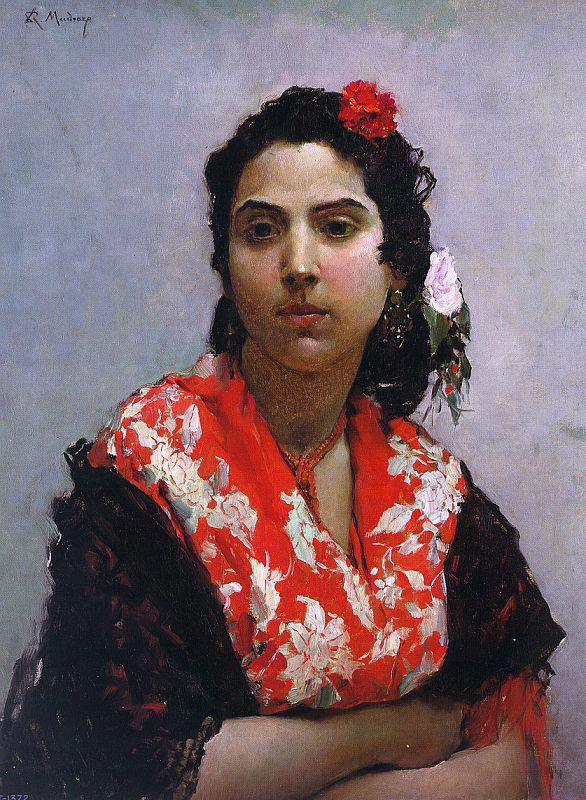
Gitana, by
Raimundo Madrazo Madrid, Museo del Prado
El Gitano por Amor was Manuel García's
last grand opera, probably begun in Mexico City in 1828, but
finished on the boat returning to France in January of 1829. A few
excerpts were printed in 1830, but the entire score, as with all
García's operas (apart from La
mort du Tasse), was never published. Indeed, there is no
evidence of the opera ever having been performed. Nonetheless, it
remains one of García's most interesting works, for it combines a
mature compositional technique (which at times looks towards
Meyerbeer) with the Spanish style with which García had begun his
career thirty years earlier in Cádiz, Málaga and Madrid. The
story, about a young man in love with a gypsy girl who demands
that he become a gypsy "for love" was probably inspired by Miguel
de Cervantes'sLa gitanilla.
The manuscript score (contained
in the Bibliothèque Nationale in Paris) reveals García's creative
process: characters changed names (Lelio evolved into Fernando,
then Hernando; Isabela became Inés; Clarillo became Manolo) and
García penned in two different texts in certain circumstances
(i.e. these double texts do not represent different verses). Since
the work was not published, it is unclear which text he would have
chosen. El Gitano por Amor is a marvelous
work. Usually when García composed he was simultaneously occupied
with a heavy schedule of performing and teaching. During the long
transatlantic voyage he could concentrate for once solely on
composition, and this is evident in the consistently high quality
of the work. El Gitano por Amor is also enormous!
The finale of Act 2 is over one thousand measures long (longer
than the finale of Beethoven's 9th). It requires a stellar cast,
all capable of vocal strength and agility. The role of Rosita is
most demanding and this was almost certainly written with the
voice of Maria
Malibran in mind: she is constantly on stage, her voice must
have the power to soar above the orchestra, yet be capable of
dealing with the most demanding florid passages—and all with
Spanish charm. The range is from high C down to E below middle C
(see No. 12, m. 673)!
Apart from Rosita, the other principal characters (Hernando, Inés,
Baldaquín, Manolo, Laura, Marqués) also have substantial music:
arias, duets, trios, quintets, and even a septet. García excelled
at writing for vocal ensembles and in El gitano por Amor
he pulled out all the stops, writing the most demanding bel
canto passages and imbuing them with an Andalusian flair.
The opera is set in an unnamed
town in Andalucía (probably Seville or its environs).
Characters:
Hernando, tenor, son of the
Marqués, betrothed to Inés Rosita, soprano, appears to be a
gypsy girl in love with Hernando, but is actually the daughter of
the Corregidor (Magistrate) Laura, mezzo-soprano, friend of
Rosita Baldaquín, baritone, servant of
Hernando Inés, soprano, beautiful and
wealthy cousin, betrothed to Hernando Manolo, tenor, brother of Rosita Marqués del Pino, baritone,
father of Hernando Corregidor, baritone, city
magistrate of [Seville], father of Rosita and Manolo Pablo, silent, companion of
Baldaquín
Act I Hernando and his family (from
Madrid) are converging on the city of [Seville], ostensibly to
celebrate the betrothal of Hernando to his cousin, the beautiful
Inés—whom Hernando has never met. But Hernando wants none of this.
He has become infatuated with the gypsy girl, Rosita.
1. Introduction.
Baldaquín, Pablo, Manolo, and chorus. Hernando's servant, Baldaquín,
and a companion, Pablo, have come in search of Hernando and find
themselves in a camp of gypsies. The gypsies sing and are
addressed by Manolo who mentions that he knows they've come to see
his sister Rosita. She's inside with Laura and will be out
shortly. The gypsies depart.
Recitative: Baldaquín curses the gypsies and
laments his having to come here on orders of the Marqués to give
Hernando a portrait of his betrothed, Inés. He suddenly sees a man
coming out of an inn and it proves to be Hernando. Baldaquín
scolds him (¿Qué, diablos, hizo?) and then tells him about the
portrait. Hernando is no longer interested in the arranged
marriage. Baldaquín surmises that Hernando has been bewitched by
some woman and warns Hernando that his father will be arriving
soon and that no pleading will change his mind.
2. Duet: "Santo Dios, ¿será
posible?" Hernando and Baldaquín Baldaquín expresses the danger
of Hernando's rashness while Hernando sings of his love for his
"linda gitana".
Recitative: Baldaquín ridicules Hernando's
love. A gypsy chorus is heard offstage. Hernando pulls Baldaquín
to the side so that they can watch the scene unobserved.
3. Chorus and aria: entrance of
Rosita. Rosita and chorus. The chorus,
"Viva el gracejo de Andalucía" prepares the entrance of Rosita
"Aquí está la gitanilla, amorosita y leal" who flirts with the men
in an aria with chorus "Venid gachoncitos". Recitative: Rosita asks
Laura what she thinks of Rosita's handling of Hernando (i.e.
wrapping the son of a marqués around her finger and demanding that
he dress like a gypsy and marry her). Laura doesn't approve. Hernando approaches, addresses
Rosita lovingly while Baldaquín expresses exasperation with his
master's behavior. Rosita tells Hernando that tomorrow she is
leaving the city, perhaps never to see Hernando again. Baldaquín
mutters that if it were his doing, he'd send her to hell! Hernando
is crushed by the thought of losing Rosita.
4. Trio: "Ay vida del alma."
Rosita, Hernando, Baldaquín The three characters express
contrasting sentiments. Rosita tells Hernando to forget her. He
says he can't and will go anywhere with her. She consents—but only
on the condition that he put on gypsy clothes. After his initial
surprise he agrees, while Baldaquín is outraged.
Recitative: Hernando and Rosita
talk of marriage while Baldaquín suggests putting Rosita on a
cruise to the Indies. Rosita runs offstage to get her brother
Manolo's consent. Baldaquín berates Hernando for not upholding the
family honor and asks Hernando to consider if he really wants to
go through life telling fortunes. Hernando tells him to shut up.
5. Aria: "Es preciso que os lo
diga." Baldaquín Baldaquín warns Hernando to
beware of gypsies—they are scoundrels who can't be trusted.
Recitative: Hernando cuffs
Baldaquín for his insolence. Rosita enters with the news that
Manolo has consented. And she has two suits of gypsy clothes.
Baldaquín asks: "Why two?" Hernando says "Stupid: If I have to
dress this way, so do you!" As Baldaquín removes his jacket the
portrait of Inés falls. Rosita demands to know whose portrait it
is. Baldaquín babbles excuses, but Rosita doesn't accept them and
accuses Hernando of philandering.
6. Trio: "No mi vida, no me
creas." Rosita, Hernando, Baldaquín Baldaquín explains the situation
and Rosita and Hernando make up.
Recitative: Rosita is still
suspicious. Manolo enters, sees the portrait of Inés and is
enraptured, while Baldaquín comments that this falling in love
business seems to be all the rage. Rosita suggests that when Inés
arrives Manolo can put on Hernando's clothes and pretend to be
him, just for fun. Hernando protests—he refuses to dishonor Inés.
Rosita flies into a rage and says that if he doesn't agree to the
game Hernando can forget her. Hernando backs down and agrees.
Manolo puts on Hernando's jacket and they all go off to join the
gypsies, leaving Baldaquín and Laura behind. Baldaquín is still
fuming about the gypsy clothes. She tells him "Go to the devil. If
you don't like it, take off the jacket". She pulls one sleeve, he
pulls another and as they tussle he starts to consider that Laura
is not so bad.
7. Duet: "Señor mío yo estoy
viendo." Laura and Baldaquín Baldaquín confesses that Laura
has him knocked head-over-heels and he'd do anything for her. They
finish the duet with a chorus in praise of the gypsy life.
8. Scene and aria: "Hernando
desaventurado." Hernando Meanwhile Hernando is having
second thoughts and he expresses guilt for betraying his father.
Yet, he confesses that it is the eyes of his "gypsy girl" that
give happiness to his soul.
9. Finale. Rosita,
Laura, Hernando, Baldaquín, chorus. The gypsies welcome Hernando as
"one of them", Rosita and Hernando sing a duet and dance,
applauded by the gypsies. Suddenly Baldaquín rushes in: "Ay,
Señor, somos perdidos." Hernando's father has arrived, is furious
and looking for Hernando. Hernando is beside himself. Rosita and
the chorus demand to know what it was that Baldaquín told him. The
mood changes and the principal characters sing metaphorically
about a ship which left port happily but now is caught in a
hurricane.
El mar turbado brama.
The violent sea rages.
Ya rota el barco mísero.
The wretched boat breaks up.
El huracán desátase,
The hurricane lets loose,
y el mástil rompe fiero.
and the mast breaks off.
Y siente el marinero
And the sailor feels
su esfuerzo desmayar.
his strength fail.
¡Piedad!
Have mercy!
Act 2 Scene: The home of Inés.
10. Cavatina: "Amor, piadoso
amor." Inés Inés longs to see the one she
adores and asks Love (piadoso Amor) to give her life.
Recitative: Inés anxiously awaits her
betrothed. Manolo enters, shows the portrait which he tells her
has received from "his" father. She believes him to be Hernando.
11. Duet: "Que placer tan
celestial" Inés and Manolo Inés and Manolo comment on the
pleasures and joy of love.
Recitative: Baldaquín is shouting. Inés asks
what the commotion is. He says it's a bunch of gypsies who want to
come in as if it were their house. Inés inquires: "They tell
fortunes, don't they?" She asks Manolo to have them come in and
tell her fortune.
12. Chorus and scene: "La gente
honrada por siempre viva." Rosita, Hernando, Baldaquín,
Laura, Inés, chorus. The gypsies greet Inés. Inés is
charmed by Rosita and asks her to sing. Rosita obliges and is
applauded by the chorus. Rosita then tells Inés that if she wishes
to have her fortune told, Rosita's "brother" (Hernando disguised
as Manolo) is the one to do it. Hernando predicts that she will
marry a man of high bearing. Inés, however, senses that something
is wrong and asks him to continue. He acknowledges that she will
have a great setback, but it will pass away. Baldaquín rushes in:
the Marqués has arrived.
Recitative: Rosita tells Inés that she can
believe everything in the fortune that her "brother" has just
told. Manolo (disguised as Hernando) suggests surprising his
"father" by hiding when he comes. Inés agrees. Inés and Manolo
exit.
13. Trio: "Adonde, bien mío, me
trajo tu amor?" Hernando, Rosita, Baldaquín Hernando wonders where his love
for Rosita has brought him. Rosita tells him not to worry. They
can think up another scheme to get them out of this trouble. Then
the three say "Hush (Chito, chito), for he's approaching."
14. Aria: "Dónde está?"
Marqués The Marqués exclaims "Where is
she, my niece?" He sees Hernando in gypsy costume among the
"rabble" but pretends not to notice so he can see "where this ends
up."
Recitative: Hernando faces his father who
comments "Gracioso traje." Hernando stutters, trying to explain,
Rosita steps in and tells the Marqués that there's nothing wrong
with a young man having fun. The Marqués acknowledges that there
is no harm done. Then Rosita explains the reason for the costumes:
Her brother and Hernando became friends years ago in Italy ("yes,"
the Marqués remembers) and Hernando suggested a prank of greeting
Inés in disguise. The Marqués exclaims "¡Qué locura!" but agrees
to go along with the scheme. Baldaquín mutters in an aside that
Rosita, with her conniving, could have been a good lawyer.
15. Finale. Rosita,
Hernando, Inés, Manolo, Laura, Marqués, Corregidor,
chorus. Quartet: "Laura, ponte en
atalaya." Rosita, Hernando, Laura, Baldaquín Rosita and Hernando tell Laura
and Baldaquín to be on the lookout in case anyone comes. Duet: "Ay, Rosita de mi vida,"
Rosita and Hernando Hernando is not happy with the
situation, but Rosita assures him that everything will turn out
all right: she has a boat ready by which the two of them will
escape. "But what about my cousin and my father?" Hernando asks.
Rosita says that her brother will invite Inés to go for a boat
ride and then will kidnap her! When Hernando protests Rosita warns
him that if he gives her a hard time, she will have his father
kidnapped as well. Hernando sings that he is horrified by the
deceit while Rosita gloats that she is, on the contrary, delighted
by the deceit. Septet: "Ay, señores de mi
alma," Rosita, Hernando, Inés, Manolo, Laura, Baldaquín, Marqués Baldaquín, who has been on
watch, cries out that government troops are at the gate and that
the Magistrate is coming to arrest everyone. Rosita exclaims that
she has been found out—but what she fears is not for her own self,
but for Hernando and how he will be humiliated. In a quartet,
Rosita, Laura, Hernando and Baldaquín lament the terrible
situation which was impossible to foresee. The Marqués, Inés and
Manolo enter. The Marqués demands to know what all the shouting is
about. Baldaquín exclaims "Ay, señores, que somos perdidos" and
explains the whole story and that Hernando was manipulated by
"that witch over there." Inés now realizes that Manolo is not
Hernando, the Marqués cries "¡Jesús, y qué tal infamia!" and
declares Hernando to be a disgrace to his family. Manolo steps
forward and tells him to calm down. But the Marqués expresses pity
for Inés while he swears to punish Rosita's audacity. Hernando
comes to her defense. But the Marqués exclaims "Hijo infame, vil y
bajo. Si de ella no te separas, he de hacer en tí un ejemplo que
hará ruido en toda España" while Rosita protests that he should
not reject Hernando on her account. Inés cries "Enough" and
intercedes with the Marqués on behalf of Hernando and Rosita.
Meanwhile Baldaquín declares that this is all the fault of these
"malditas gitanas." Laura tells him not to blame the gypsy girls,
for nothing will come of this. As the septet comes to a climax,
the Magistrate (Corregidor) enters.
Scene: "Qué estruendo es este?" the above and
Corregidor The
Magistrate demands to know what all the noise is about. The
Marqués says he has come just in time and demands that he arrest
all this riffraff who have taken advantage of him—"including that
miserable son of mine." But Manolo approaches the Magistrate
("Señor...") who is dumbfounded when he sees Manolo: "¿Qué miro?
El es... ¡Cielo Santo! No hay que dudar: ¡Hijo mío!" Yes, it is
his long-lost son! Manolo explains that when he had killed the
Duke of Robles in a duel he was obliged to run away. To avoid
being caught he took refuge among a band of gypsies. And there he
made the most joyful discovery... Manolo shows a jewel to the
Magistrate and asks "Do you recognize this?" The Magistrate
exclaims that it is the same that his daughter wore when she was
kidnapped years ago. "Where is she?" he demands. Rosita kneels
before him. She then sings how when Manolo came to the gypsies an
old woman recognized him and later, when she was on her deathbed,
she called him to her, confessed, begged his forgiveness, and
proved the veracity of her claims with the jewel and other signs.
"Why didn't you come to me at once?" the Magistrate asks. Rosita
says that since Manolo was afraid of the law, they came to the
city in disguise and it was only fortune that has now brought them
all together. She begs that he have pity on them while the chorus
sings "Surely it is she, there is no reason to doubt." The
Magistrate says to Rosita, "Come, my child, come embrace me." And
Hernando asks the Marqués to pardon him. Rosita asks the
Magistrate now to make her happiness complete. "How?" he asks. By
consenting to her marriage to Hernando. The Magistrate says it is
fine with him if the Marqués agrees. The Marqués in turn will
agree if Inés agrees. She does [presumably she's content to have
Manolo!]. Baldaquín feels left out: no one has arranged a marriage
for him. Laura suggests why not marry her? Baldaquín takes her
hand: "Marriage it shall be!" Chorus: "Ay, ay, ay, tin,
tin" and duet:
"De contento yo deliro." Hernando and Rosita The gypsies
sing and dance while Hernando and Rosita sing:
(Hernando)
(Hernando) De contento yo deliro.
I am delirious with happiness,
Con
esta rosa de abril.With this April rose.
Si
la miro me deshago If I look at it I fall
apart
y me empiezo a derretir.
and I being to melt.
(Rosita)
(Rosita)
Cuando el amor se apodera
When love takes hold,
el pecho no es de marfil.
one's breast is not made of
ivory.
Por eso nadie ha podido
Therefore no one has ever
been able
la natura resisitir.
to resist nature.
PLEASE
NOTE: In my opinion, El gitano por
amor is García's masterpiece. For the last
fifteen years I have tried to persuade publishers
("editoriales") to publish the score and opera companies to
perform it —all to no avail. I have recently revised my
original transcription (done in 1999) and it is ready to be
performed. If anyone is interested, please let me
know! J.R.
ACT 1 OVERTURE
Please note: An error in the overture has been corrected as of the
latest update (May 16, 2016) of this website. I am indebted to Dr.
David Hagy of Wake Forest University for bringing this to my
attention. I had been aware of a strange modulation at measure 27
but, since García occasionally has quirks in his scores, I thought
that it was perhaps just a compositional error on his part. After
further examination of the manuscript, however, it was determined
that when it had been bound (by his daughter Pauline) the order of
two pages had been mixed! This solved the problem. Dr. Hagy
prepared the score for the modern world premiere performance by
the Wake Forest University Orchestra on April 27, 2016. NO.
1, INTRODUCTION (Chorus, Baldaquín, Manolo) RECITATIVE
AFTER NO. 1 NO.
2, DUET (Baldaquín, Hernando) RECITATIVE
AFTER NO. 2 NO.
3, CHORUS AND ARIA (Chorus, Rosita) RECITATIVE
AFTER NO. 3 NO.
4, TRIO (Hernando, Rosita, Baldaquín) RECITATIVE
AFTER NO. 4 NO.
5, ARIA (Baldaquín) RECITATIVE
AFTER NO. 5 NO.
6, TRIO (Hernando, Rosita, Baldaquín) RECITATIVE
AFTER No. 6 NO.
7, DUET (Laura, Baldaquín) NO.
8, SCENE AND ARIA (Hernando) NO.
9, FINALE
CLICK TO DOWNLOAD AUDIO CLIPS OF SYNTHESIZED PERFORMANCE:
(It sounds artificial, but nevertheless gives an idea of the
music. If you first download the score to your desktop you can
follow the score while listening. I do not provide audio clips of
the recitatives.)